[:eo]Enkonduko
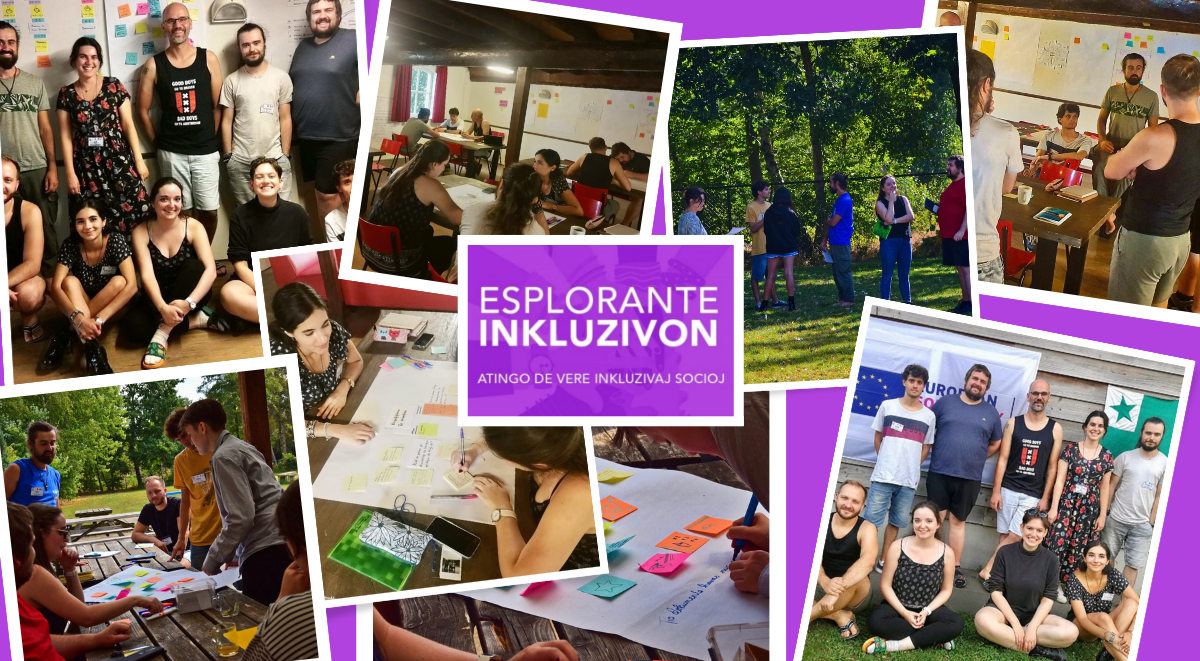
Inter la 21-a kaj la 25-a de Aŭgusto 2022, gejunuloj el Eŭropo havis la ŝancon renkontiĝi en Nederlando por lerni kaj interŝanĝi siajn ideojn pri socia inkluzivo en la internacia seminario “Esplorante Inkluzivon – Atingo de vere inkluzivaj socioj”. La seminarion organizis TEJO en Nederlando en Aŭgusto 2022, kun financa subteno de la Eŭropa Junulara Fondaĵo de la Konsilio de Eŭropo. Dum la seminario oni starigis la jenajn demandojn – kiu(j) estas socie ekskludita(j) en niaj socioj? Kio influas nian socian inkluzivon kiel junuloj? Kiel KOVIM-19 influis nian inkluzivon, kaj kion oni povas lerni de tio?
Komence de la dokumento, vi trovos niajn rekomendojn pri kiel deciduloj povas agi por atingi pli inkluzivajn sociojn je regiona, nacia kaj internacia skalo. Fine de la dokumento, vi trovos kolekton de niaj respondoj al tiuj demandoj.
Rekomendoj
Dum nia tempo kune, ni informiĝis pri identeco, socia inkluzivo kaj ekskludo, kaj la efikoj de la KOVIM-19-pandemio. En ĉi tiu deklaracio, ni proponas multajn pensojn kaj ideojn pri socia inkluzivo. La sekvaj punktoj estas tiuj, kiuj aperis en niaj diskutoj per la perspektivoj kaj de niaj propraj vivspertoj kaj de la KOVIM-19-pandemio. Pro tio, ni identigis ilin kiel la ŝlosilaj elementoj en la atingo de inkluzivaj post-pandemiaj socioj.
- Aliro al interreto kaj komputiloj, kaj ankaŭ al la kompetencoj por povi uzi ilin
- Reta senpaga aŭ pagebla altkvalita edukado, specife lingvolernado
- Pageblaj, altkvalitaj kaj ekologiaj transportsistemoj, regione, nacie kaj internacie
- Fleksebla kaj alirebla reta laboro
- Rekono de la graveco de neformalaj spacoj kaj potencdinamikoj
- Konscio kaj rimedoj rilate al la graveco de mensa sano kaj sanservo, specife en lernejoj
- Spacoj, fizikaj aŭ virtualaj, por ke homoj kuniĝu kaj umu kun aliaj en sia propra socia grupo, sed ankaŭ spacoj kie homoj povas dialogi kaj interŝanĝi kun membroj de aliaj sociaj grupoj
Malgraŭ ĉiuj negativaj konsekvencoj de la pandemio, ĝi ankaŭ estis tempo, kiam niaj sociaj normoj kaj kutimoj estis tute defiitaj, foje ŝanĝiĝantaj al pli bone. Dum KOVIM-19, novaj manieroj labori, studi, sociumi kaj vidi la mondon aperis.
Nia deziro estas, ke la scio kaj ideoj akiritaj de tiuj defioj estu uzataj por ŝanĝi niajn sociojn, kreante pli egalan, ekologian kaj inkluzivan mondon.
Fono
Kiuj estas socie ekskluditaj en niaj socioj?
En ĉiuj socioj hodiaŭ, homoj daŭre suferas socian ekskludon surbaze de membreco de kelkaj sociaj kategorioj.
Inter tiuj sociaj kategorioj, la plej videblaj diskriminacioj okazas surbaze de genra identeco (precipe virinoj kaj genraj nekonformaj homoj), nacieco, civitana statuso, rasigita statuso kaj/aŭ etna fono (ekz. enmigrintoj, romaoj, koloraj homoj), kaj GLAT+ statuso (ekz. gejaj homoj, transgenruloj). Tamen, socia ekskludo ankaŭ okazas surbaze de politikaj kaj religiaj orientiĝoj, same kiel aĝo kaj kapablo.
Tiuj en pluraj kategorioj ofte suferas plej, pro la intersekcia eco de tiuj diskriminacioj (cigana persono suferas diskriminacion surbaze de sia statuso kiel “alia” raso, sia nacieco, civitaneco, gepatra lingvo, ktp.).
Kio influas nian socian inkluzivon kiel junuloj?
Malgraŭ niaj diversaj spertoj kaj fonoj, ni trovis komunajn karakterizojn, kiuj influis nian politikan, socian, kulturan kaj ekonomian inkluzivon. Ili estis:
- familia socio-ekonomia statuso / privilegio
- loĝloko (ekz. urba, kampara, Eŭropo, Schengen-spaco)
- fizika kaj mensa sano kaj aliro al sansistemo
- aliro al oportunoj por junuloj kiuj eklaboras
- aliro al politika reprezentado de junuloj / junulaj vidpunktoj
- nivelo kaj speco de edukado
- aliro al politikaj rajtoj kiel necivitano
- lingva scipovo (ekz. kapablo paroli la anglan)
- engaĝiĝemo kaj memfido
- interkulturaj rilatoj
El ĉi tiuj temoj, la 3 pri kiuj ni elektis koncentriĝi estis:
- aliro al oportunoj por junuloj kiuj eklaboras
- engaĝiĝemo kaj memfido, kaj
- interkulturaj rilatoj
Aliro al oportunoj por junuloj kiuj eklaboras
Junuloj klare alfrontas unikajn defiojn rilate al ekonomia inkluzivo. Specife, junuloj ofte penadas por eklabori, ofte havante akademiajn kvalifikojn sed malmulte da sperto. Dum la lastaj jaroj, KOVIM-19 ankaŭ multe influis la aliron al laboro por junuloj, eble rezultigante kontinuajn ŝanĝojn en la ekonomia panoramo por junuloj.
Nevolemo de dungantoj riski havi pli junajn kandidatojn
Dungantoj povas preferi kandidatojn kun pli da sperto aŭ volas eviti la necesajn kostojn kaj tempon por trejni junulon. Ili ankaŭ povas taksi junulojn kiel malpli fidindajn, kaj deziras eviti la mallongatempajn kontraktojn kiuj favoras studentojn.
- Ni devas normaligi la lernadon de tiuj junuloj kiel imanenta parto de dinamika kaj inkluziva laborejo.
- Registaroj povas proponi financajn avantaĝojn al kompanioj, kiuj dungas junulojn kaj studentojn.
- Firmaoj povas pagi pli malaltajn salajrojn al junuloj por komenca periodo, sed interŝanĝe prenas la respondecon garanti ilian edukadon kaj trejnadon.
- Leĝaro povas esti ŝanĝita por faciligi la dungadprocezon de mallongdaŭraj laboristoj.
- Lokaj kaj regionaj asocioj, kiuj proponas staĝojn kaj laborspertajn ŝancojn, povas esti subtenataj kaj promociitaj (ekz. la “Service Civique” modelo en Francio).
Troa emfazo de akademia edukado
Universitata edukado estas aprezata super aliaj formoj de edukado, kaj kulture kaj ekonomie. Junuloj estas kuraĝigitaj celi universitatan edukadon kiel eble plej multe. Tamen, tiu fokuso pri akademia studado signifas, ke al studentoj eble mankos tempo kaj ŝanco trovi laboroportunojn. Ĝi ankaŭ povas rezultigi, ke al multaj el tiuj junuloj mankas la praktikaj kapabloj utilaj por trovi laboron.
- En mezlernejoj, pli praktika instruado (kuirado, mastrumado de personaj projektoj, riparoj) povas doni al junuloj sperton pri praktikaj kapabloj kaj permesi al ili konsideri diversajn tipojn de laboro.
- Universitataj programoj povas esti adaptitaj por normaligi kaj instigi pli praktikan laborsperton kaj staĝojn por studentoj kune kun iliaj studoj.
- Skemoj de “Komerca inkubatoro” povas esti realigitaj en pli da EU-landoj, por subteni junulojn, kiuj volas krei siajn proprajn firmaojn.
Malegaleco de ŝancoj surbaze de geografio
Pro Eŭropa Unio, eblas translokiĝi por studi kaj labori en aliaj landoj. Tamen, ekzistas ankoraŭ granda diferenco de oportunoj inter tiuj kiuj vivas en pli riĉaj kaj pli malriĉaj landoj, same kiel tiuj kiuj vivas en urbaj kaj kamparaj lokoj. La KOVIM-19-pandemio ankaŭ akcentis la neceson havi aliron al bonkvalita komputilo kaj interreta konekto por laboro kaj studo.
- Leĝaro povas esti adaptita aŭ kreita por faciligi la dungadon de junuloj el aliaj landoj.
- La sukceso de aplikaĵoj kiel Duolingo kaj Mango Languages pruvas la intereson pri alireblaj kursoj por lerni lingvojn. Alireblaj kaj altkvalitaj lingvokursoj, haveblaj en sia gepatra lingvo, povas ebligi al junuloj lerni utilajn kapablojn kaj vojaĝi al aliaj landoj por laboro kaj studeblecoj.
- Registaroj povas prioritatigi infrastrukturon, kiu certigas interreton por tiuj en malavantaĝaj aŭ kamparaj lokoj.
- Diversaj subvencioj kaj asocioj povas labori por provizi decajn komputilojn al homoj el malavantaĝaj grupoj, por ke ili havu pli da oportunoj. Tio ankaŭ povas inkluzivi trejnadon kaj laborrenkontiĝojn pri kiel uzi ilin, precipe por pli maljunaj generacioj.
- Bona publika transporto inter urboj kaj eĉ landoj povas ebligi aliron al multaj pliaj laborŝancoj. Registaroj povas prioritatigi tiun infrastrukturon kaj proponi strategion por igi ilin atingeblaj por junuloj kaj por tiuj de malavantaĝaj grupoj.
- La scio kaj sperto akiritaj dum la pandemio (kiel labori hejme, kiel organizi retajn projektojn kaj eventojn) povus esti uzataj por krei kaj proponi retajn staĝojn kaj laborspertajn oportunojn.
- Tiuj samaj scioj kaj spertoj povus esti aplikataj ĉe EU-nivelo, por krei trejnajn oportunoj por junuloj rete (seminarioj, kursoj, kiel labori de hejmo, ktp.).
Engaĝiĝemo kaj memfido
Temo, kiu aperis plurfoje dum niaj diskutoj, estis tiu de engaĝiĝemo kaj memfido. La emo kaj fido paroli kaj uzi oportunojn povas esti grandega faktoro en onies inkluzivo, precipe en la politikaj sferoj. Tamen, tio ne estas temo, kiun oni kutime esploras kiam oni diskutas pri socia inkluzivo, pro sia individua atributo. Tial necesas alia vidpunkto – analizi la engaĝiĝemon kaj memfidon de junuloj kiel faktoron kiu povas esti influita sur la loka, regiona kaj nacia nivelo, kaj ne simple kiel individua problemo.
Manko de subteno de pli maljunaj aŭtoritatuloj
Junuloj ofte aŭdas kaj internigas mesaĝojn de la aŭtoritatuloj ĉirkaŭ ili, ke ilia vidpunkto ne gravas; ke ili estas tro junaj aŭ mankas la sperto por havi opinion, aŭ ke ili scias nenion pri la “reala mondo”. Aliaj oftaj mesaĝoj, kiel “aferoj neniam ŝanĝiĝos” kaj “vi neniam sukcesos”, plue difektas memestimon kaj malkuraĝigas junulojn preni iniciaton kaj labori por socia inkluzivo. Ĉar tiuj dinamikoj okazas plejparte en privataj spacoj, kiel la hejmo, ili estas malfacile kontraŭbatali de politika perspektivo.
Manko de konscio pri la ŝancoj jam disponeblaj por junuloj
Kune kun tiuj negativaj mesaĝoj, kiuj malkuraĝigas junulojn agadi, ofte mankas konscio pri la subtenoj, projektoj kaj oportunoj, kiuj jam ekzistas por junuloj – manieroj engaĝiĝi en loka politiko, internaciaj interŝanĝoj, trejnaj oportunoj, retoj, registaraj programoj. Tio konfirmas la ideon, ke junuloj ne havas potencon ŝanĝi aferojn.
- Neformala edukado estas grava ilo por povigi junulojn. Kun pli da scio kaj sperto, junuloj povas akiri fidon kaj senton de legitimeco por paroli kaj agadi. Ili povas esprimi sin malsame ol en formala lerneja medio, kaj ili povas profiti el renkontiĝi kun kaj lerni de aliaj junuloj kun malsamaj vivspertoj.
- Reprezentado de junuloj en decidfaradaj spacoj estas grava, ne nur rilate inkluzivon, sed ankaŭ por lasi ilin konscii, ke iliaj voĉoj kaj kontribuoj estas aprezataj. Tiuj junuloj eĉ povas fariĝi modeloj aŭ inspiri aliajn agi.
- Lokaj asocioj aŭ lernejoj povus krei spacojn specife por povigi diskuton kaj agadon inter junuloj, kie ili povas trovi mentorojn, rimedojn aŭ subtenon aŭ konsilon pri ideoj.
Timo de juĝo hejme kaj en la lernejo
Por junuloj precipe, timo de negativa ekstera juĝo de aŭtoritatuloj (gepatroj, instruistoj) aŭ samideanoj (amikoj, samklasanoj) povas malhelpi ilin esprimi sin aŭ stariĝi kontraŭ ekskludo.
- Konsciigi instruistojn kaj edukistojn pri la negativaj efikoj, kiujn kritiko kaj honto povas havi por mensa sano kaj memestimo de studentoj.
- Efektivigi kromajn ilojn kaj enketojn en lernejoj por certigi, ke instruistoj ne misuzas sian potencon kaj ke studentoj estas respektataj.
- Trejni instruistojn kaj edukistojn pri la graveco de pli sekuraj kaj ne-juĝaj spacoj por studentoj, kaj ankaŭ strategiojn pri kiel krei ilin en klasa medio.
- Instrui studentojn pri sanaj rilatoj kaj mensa sano, esplorante ilojn por komuniki efike kaj juste. Doni al ili rimedojn kaj spacon por povigi ilin trovi siajn proprajn manierojn trakti konflikton kaj negativan juĝon de aliaj.
Socio konstruita por ekstravertuloj
Multaj junuloj volas uzi oportunojn aŭ pli engaĝiĝi en siaj komunumoj, sed sentas, ke ili ne estas sufiĉe ekstravertitaj. Politika ago precipe estas rigardata kiel postulanta certan tipon de personeco por sukcesi – ambicia, komforta kun publika parolado, povas akcepti kritikon, ktp. Lernejoj povas trakti la emon silenti kiel patologion kiu devas esti korektita. Malemo paroli ofte estas ligita kun malalta memestimo aŭ timo de juĝo, sed provoj korekti tion devigante iun paroli nur plimalbonigos tion.
- Edukistoj kaj faciligantoj povas esti trejnitaj por enkonduki kaj normaligi malsamajn formojn de komunikado, ekz. la kapablo partopreni per skribado / tekstado.
- Ili ankaŭ povas klopodi integri laboron en grupetoj aŭ paroj, por ke la studentoj sentu malpli da premo dum parolado.
- Kursoj pri parolado povas helpi venki timon kaj doni fidon pri parolado, sed unue krei kaj certigi subtenantan kaj senjuĝan medion estas gravega. Sen tio, junuloj kiuj estas devigitaj publike paroli povas senti sin humiligitaj kaj malpli emos paroli ol antaŭe.
Stigma ĉirkaŭ mensaj sanproblemoj kaj sansistemo
Mensa sano estis taksita kiel grandega faktoro en la bonfarto kaj emo de la junularo engaĝiĝi. Dum la pandemio, eble pli da junuloj ol iam ajn suferis negativajn mensajn sanajn rezultojn pro socia izolado kaj labor/studa malstabileco. Tamen, restas multe da stigmo ĉirkaŭ mensaj sanproblemoj, kaj aliro al bonkvalita prizorgado daŭre estas defio en multaj lokoj.
- Registaroj, asocioj kaj lernejoj povas kunlabori por eduki kiel eble plej multajn homojn pri la graveco de mensa sano kaj emocia bonfarto.
- Instruistoj ĉefe povas normaligi konversaciojn pri mensa sano kaj serĉi helpon, kiel iri al lerneja konsilisto.
- Naciaj kaj regionaj sansistemoj povas esti ŝanĝitaj por plibonigi la kvaliton kaj disponeblo de mens-sanaj sistemoj por ĉiuj.
Interkulturaj rilatoj
Eble pro la internacieco de nia grupo, alia temo kiu aperis plurfoje estis la efiko de internaciaj rilatoj al socia inkluzivo. Tiu temo ofte estas analizita laŭ sia negativa efiko, rilate al la efikoj de ksenofobio kaj rasismo sur socia inkluzivo. Ni volas koncentriĝi pri kiel interkulturaj rilatoj ankaŭ povas havi pozitivajn efikojn al socia inkluzivo, kaj kiel plej bone kontraŭbatali la efikojn de ksenofobio kaj rasismo.
Sociaj grupoj tendencas resti kaj interagi sole ene de siaj propraj komunumoj
Eĉ en landoj kun grandaj enmigrintaj populacioj, malsamaj etnoj ofte vivas kaj interagas sole en siaj propraj komunumoj. Malgraŭ la natura scivolemo de homoj pri aliaj kulturoj (muziko, kuirarto, lingvo), tiu manko de agnosko kaj interago kun homoj de aliaj kulturoj povas plifortigi nescion kaj antaŭjuĝon.
- Financa subteno povas esti asignita al malsamaj grupoj kaj asocioj por aranĝi interkulturajn eventojn, ekspoziciojn kaj forumojn, por ebligi homojn lerni pri malsamaj kulturoj rekte de aliaj kiuj apartenas al tiu kulturo.
- Urba ĝemeliĝo povas esti efika maniero krei interkulturajn interŝanĝojn kaj kuraĝigi amikecon inter diversaj landoj. Tio ankaŭ povas esti maniero emfazi kaj esplori historion inter du landoj.
- Proponi senpagan eniro al kulturaj eventoj por necivitanoj povas ebligi transkulturan lernadon kaj interŝanĝon.
- Reprezentado gravas! Diverseco devus esti videbla kaj valorigita en la amaskomunikilaro. Interkultura interŝanĝo povas esti valorigita kaj normaligita per konstruado de partnerecoj inter amaskomunikiloj de malsamaj landoj.
Registaroj ofte havas propran intereson valorigi naciisman kaj malpartian perspektivon kiu favoras la status quo
Por protekti kaj legitimi ilian strukturon kaj daŭrigon, registaroj reklamas certajn vidpunktojn aŭ raportojn pri historio. Tio permesas al ili protekti la povhavantulojn, kaj konservi fortan senton de nacia identeco kiu pravigas kaj vidigas la registaron. Potencaj iloj por devigi la naciisman vizion de registaro estas kulturo, amaskomunikilaro kaj edukado, kie historio kaj identecoj estas reprezentitaj kaj diskutitaj.
- Neŭtralaj strukturoj estas necesaj por monitori Ŝtatajn amaskomunikilojn kaj teni ilin respondecaj pri partia raportado – specife kiam temas pri polarizaj temoj kiel koloniismo, sklaveco kaj genocido.
- Lernejaj programoj povas esti ĝisdatigitaj por ebligi al infanoj lerni pri malsamaj lingvoj, kulturoj kaj religioj, kaj ankaŭ pri la graveco de diverseco kaj respekto.
- Interkultura aliro devas esti konsiderata kiam oni laboras pri leĝaro. La leĝo de teritorio devus konsideri la diversecon de kulturoj ekzistantaj en ĝiaj limoj. Ekzemple, reprezentantoj de malsamaj kulturoj devus esti enplektitaj por krei parlamenton kiu protektas la rajtojn de ĉiu civitano, inkluzive de tiuj el minoritataj kulturoj.
- Publikaj agentoj kaj sociaj laboristoj devus esti trejnitaj pri interkultureco, kaj trejnadskemoj devus prioritatigi lernadon rekte de kaj kun minoritataj grupoj.
La angla lingvo estas maljuste prioritatita en internacia komunikado
La uzo de la angla kiel internacia lingvo en multaj kampoj – politiko, kulturo, komerco – kreas malegalecojn kaj inter landoj kaj inter individuoj. Esti denaska parolanto de tio, kio estas konsiderata norma angla (kutime brita aŭ usona) fariĝas grandega valoro por individuo, kaj landoj kiuj uzas la anglan kiel nacian lingvon disvolvas pli malmolan kaj mildan povon. La angla kiel internacia lingvo plifortigas diskriminacion inter tiuj, kiuj parolas la anglan kiel denaska lingvo, tiuj kiuj povas pagi por lerni la anglan, kaj tiuj kiuj ne povas. Tiu hierarkio plifortigas malegalecojn kiuj jam ekzistas pro historiaj tutmondaj fluoj kiel sklaveco aŭ koloniismo.
- Esperanto, internacia lingvo kreita por esti kiel eble plej facile lernebla, estas solvo de tiu ĉi hierarkio. Ĝi estu instruata en lernejoj kaj enkondukita en internaciaj partneradoj, kiel efika kaj pli egala formo de internacia komunikado.
- La farebleco kaj ŝparado enkondukante Esperanton kiel lingvo de Eŭropa Unio estu zorge konsiderataj, ĉar iuj esploroj jam asertis, ke ĝi estus pli ekonomie realigebla ol la uzo de la angla.
Kion ni povas lerni de la KOVIM-19-pandemio?
La KOVIM-19-pandemio, kiu komenciĝis en 2020, alportis multajn radikalajn ŝanĝojn en modernaj socioj. Ĝi elmontris multajn temojn aŭ tendencojn en socioj, kiuj ĝis tiam ne estis tiel videblaj. La lecionoj, kiujn ni lernas de KOVIM-19, estas gravegaj por forĝi vojon al pli inkluzivaj socioj.
KOVIM-19 kaj interreto
La movo al la interreto altigis la aliron al laboro kaj edukado por multaj homoj, sed ankaŭ kondukis al novaj defioj.
- Novaj manieroj por havi aliron al sanservon per telefonaj aŭ interretaj servoj igis ilin pli alireblaj…
- Ni devas daŭrigi kun tiu sukceso kaj certigi daŭran aliron al respondemaj kaj efikaj interretaj sanservoj.
- Multe da laboro iĝis reta laboro, igante ĝin pli alirebla, kaj donante pli da libereco al la dungitoj rilate laborhorojn aŭ metodojn. Dum izoliĝo havis longdaŭrajn negativajn efikojn por mensa sano kaj socia vivo, multaj homoj trovis, ke kromefiko de trudizoliĝo kaj laborado hejme estis pasigi pli da tempo kun familio.
- Havi la flekseblecon labori de hejmo ebligas laboron por homoj kiuj eble ne povis antaŭe (novaj gepatroj, homoj kun certaj handikapoj) kaj havas pozitivajn efikojn por la bonfarto de multaj homoj.
- En la kampo de edukado, movado de kursoj al interreton farigis ilin pli alireblaj por multaj homoj, kaj permesis al studentoj pasigi malpli da tempo en publikaj transportoj. La fermo de multaj lokoj pro la kvaranteno kondukis multajn homojn lerni novajn kapablojn per interreto, ekzemple ĉe Duolingo. Tamen, por homoj kun malbona aŭ neniu aliro al interreto, ĝi havis la kontraŭan efikon, malproksimigante ilin de lernejoj aŭ universitatoj. Por tiuj, kiuj diplomiĝis dum la pandemio, la transiro al interreta edukado signifis ke tiuj kvalifikoj havas malpli grandan valoron en la labormerkato.
- Kvalita aliro al interreto kaj funkcianta komputilo estas praktika neceso en la nuna mondo. Ankaŭ estas grave disvolvi kaj plibonigi interretan edukadon, por ke ĝi havu la saman valoron kaj kvaliton kiel persona edukado. Senpaga kaj altkvalita edukado, inkluzive de lingvolernado, eblas per interreto, kaj devus esti evoluigita.
- Multaj studentoj suferis pro socia izolado, ĉar havi interretajn kursojn ne havis la socian aspekton de fizikaj kursojn. Aliflanke, iuj studentoj, kiuj estis ĉikanitaj (bullied) en lernejoj, preferis la kvarantenon, ĉar ili jam spertis socian izoladon dum lerneja tempo.
- Lernejoj estas esencaj por la mensa sano kaj socianiĝo de junuloj. Tamen, pli ol esti malfermitaj denove, ili nepre devas fariĝi lokoj kie ĉiu studento sentu sin sekura kaj subtenata.
KOVIM-19 kaj enspez-sekureco
La malegaleco inter la malsamaj grupoj kiuj estis trafitaj de la pandemio emfazis la gravecon kaj potencon de fortaj sistemoj de socia sekureco.
- La pandemio emfazis la malstabilecon de multaj laborpostenoj, precipe por homoj, kiuj jam suferis dungan malfortikecon pro sia aĝo, sekso, civitaneco aŭ aliaj faktoroj. Por multaj homoj, tiu malstabileco kondukis al financaj problemoj, kaj povus esti akompanata de la perdo de aliaj avantaĝoj, kiel ekzemple sanservo. Kun financa malsekureco venis multe da streso por multaj laboristoj.
- Por tiuj, kiuj havis pozicion aŭ loĝis en lando, kie aliro al baza enspezo estis certigita, ilia vivokvalito kaj bonfarto estis multe malpli influitaj de la KOVIM-krizo.
- Universala baza enspezo estas potenca strategio kontraŭ malriĉeco kaj socia ekskludo.
KOVIM-19 kaj socia ŝanĝo
La drastaj kaj rapide moviĝantaj ŝanĝoj en la socio emfazis kaj la bezonon kaj la eblecojn por daŭra politika kaj socia ŝanĝo.
- Du jarojn post la komenco de la KOVIM-pandemio, laboro hejme fariĝis tre ofta. Miksitaj laborhoraroj, kun laboro hejme kaj laboro en la tradicia laborejo nun estas tre normaligitaj.
- Tio montras kiel radikalaj ŝanĝoj en niaj socioj eblas, kaj specife havi pli da fleksebleco pri kiel kaj kiam ni laboras.
- La viruso evidentigis la konsekvencojn de mondvarmiĝo. La ekonomia halto kaj vojaĝaj malpermesoj de la tempo de kvaranteno emfazis la efikon de la ekonomio kaj vivstiloj de riĉaj landoj sur la ekosistemo.
- Oni devas preni drastajn mezurojn por ĉesigi klimatan ŝanĝon, surbaze de tio, kion ni observis dum izoliĝo.
- La pandemio evidentigis kaj plifortigis la kreskon de malegalecoj kaj socia ekskludo je multaj skaloj. La izoliĝo limigis politikan esprimon kaj draste ŝanĝis la politikan pejzaĝon, kaj la kapablon de homoj partopreni en politiko. Ekzemple, la kvaranteno kaŭzis altigon de hejma perforto, ĉar la viktimoj de hejma violento devis resti hejme kun siaj misuzantoj.
- Ni povas lerni de tiu kazo, ke politikfaristoj devas konsideri potencodinamikon sur la mikronivelo kaj en neformalaj spacoj. Fidindaj subtenaj retoj por viktimoj devas esti kreitaj, kaj la reprezentantoj de leĝo kaj sociaj laboristoj devas esti trejnitaj pri intersekcecio kaj la dinamiko de misuzo. Longperspektivaj ekonomiaj solvoj kiel universala enspezo ankaŭ povus helpi la financan emancipiĝon de viktimoj de perforto.
- KOVIM-19 kaŭzis la nuligon de multaj kulturaj eventoj. Aliflanke, ni lernis kiel organizi retajn eventojn. Novaj manieroj por krei kaj kundividi arton ekestis, kaj permesis al homoj kiuj kutime ne partoprenis en kulturaj okazaĵoj fari tion.
- Interreto estas potenca ilo por alirebla kaj socie inkluziva kulturo: ĝi helpis evoluigi novajn manierojn krei arton.
KOVIM-19 kaj la homa kapablo adaptiĝi
La tutmonda krizo kondukis al senprecedencaj defioj por la homaro, sed ankaŭ multmaniere evidentigis la adapteblecon de homoj, kaj ilian rezistecon alfrontante drastan ŝanĝon en iliaj kutimoj.
- Ekzemple, studentoj trovis manierojn transformi retajn prelegojn kaj ekzamenojn en io avantaĝa: ili kundividus siajn sciojn kun siaj samklasanoj dum ekzamenoj, kreante sociajn ligojn malgraŭ la interreta medio, kaj helpante unu la alian pasigi siajn klasojn dum ĉi tiuj malfacilaj tempoj.
- Fermo de limoj ankaŭ igis multajn homojn vojaĝi en sia propra lando anstataŭ eksterlande. Tio permesis al multaj homoj lerni pli pri sia propra kulturo, kaj adopti pli ekologian manieron vojaĝi.
- Pagebla regiona transporto estas grava, ne nur por kultura kaj ekonomia inkluzivo, sed ankaŭ en la vojo al ekologiaj socioj en la batalo kontraŭ klimata ŝanĝo.
[:en]Introduction
Between the 21st and the 25th of August 2022, young people from throughout Europe had the opportunity to come together in the Netherlands to learn and exchange their ideas about social inclusion in the international seminar “Exploring Inclusion – No one left behind: Achieving truly inclusive societies”. The seminar was organized by TEJO, co-founded by the European Youth Foundation and the Council of Europe in the Netherlands in August 2022. During the seminar, we asked ourselves the following questions – who is socially excluded in our societies? What influences our social inclusion as young people? How has COVID-19 affected our inclusion, and what can we learn from this?
At the beginning of the page, you will find our recommendations on how decision-makers can act to move towards more inclusive societies on the regional, national, and international levels. In the end of the page, you will find a collection of our answers to these questions.
Recommendations
In our time together, we explored questions of identity, social inclusion and exclusion, and the effects of the COVID-19 pandemic. In this declaration, we have presented many thoughts and ideas on social inclusion. The following points are those which came up in our discussions through both the perspective of our own life experiences and the COVID-19 pandemic. Because of this, we have identified them as the key elements in the move to inclusive post-pandemic societies.
- Access to Internet and computers, as well as the skills to use them
- Online free or affordable high-quality education, specifically language learning
- Affordable, high-quality and ecological transport systems, regionally, nationally, and internationally
- Flexible and accessible online work
- Recognition of the importance of non formal spaces and power dynamics
- Awareness and resources regarding the importance of mental health and healthcare, specifically in schools
- Spaces, physical or virtual, for people to gather and be together with others in their own social group, but also spaces where people interact and exchange with members of other social groups.
Despite all the negative consequences of the pandemic, it was also a moment where our social norms and habits were completely questioned, sometimes changing for the better. During COVID-19, new ways of working, studying, socialising and viewing the world came into being.
Our wish is that the knowledge and ideas gained from these challenges is used to change our societies, creating a more equal, ecological, and inclusive world.
Background
Who is socially excluded in our societies?
Throughout all our societies today, people still suffer social exclusion based on their membership of certain social categories.
Among these social categories, the most visible discriminations occur based on gender (especially women and gender non-conforming people), nationality, citizenship status, racialised status and/or ethnic background (eg. immigrants, Roma, people of colour), and LGBT+ status (eg. gay people, transgender people). However, social exclusion also happens based on political and religious orientations, as well as age and ability.
Those in multiple categories often suffer the most, due to the intersectional nature of these discriminations (a Roma person suffers discrimination based on their status as an “other” race, their nationality, citizenship, native language, etc.).
What influences our social inclusion as young people?
Despite our diverse experiences and backgrounds, we found common threads that influenced our political, social, cultural and economic inclusion. These were:
- socio-economic status of one’s family
- area of residence (eg. urban, rural, European, Schengen)
- physical and mental health status and access to healthcare
- access to opportunities for young people starting work
- access to political representation of young people and their views
- level and type of education
- access to political rights as a non-citizen
- language proficiency (eg. ability to speak English)
- personal initiative and self-confidence
- intercultural relations (ie. the relationships and relative standing of one’s country or culture)
Out of these topics, the 3 that we chose to focus on were:
- access to opportunities for young people starting work,
- personal initiative and self-confidence, and
- intercultural relations.
Access to opportunities for young people starting work
It is clear that young people face unique challenges regarding economic inclusion. Specifically, young people often struggle to start out in the workforce, often having academic qualifications but little to no experience. Over the last few years, access to work for young people was also greatly impacted by the COVID-19, perhaps leading to permanent changes in the economic landscape for young people.
Unwillingness of employers to take a risk on younger candidates
Employers may prefer candidates with more experience or want to avoid the costs and time necessary in training a young person. They may also view young people as less reliable, and wish to avoid the short-term contracts that favour students.
- We need to normalise the learning process of these young people as an intrinsic part of a dynamic and inclusive workplace.
- Governments can offer financial benefits to companies that employ young people and students.
- Companies can pay lower wages to young people for an initial period, but in exchange take the responsibility of ensuring their education and training.
- Legislation can be changed to facilitate the employment process of short-term workers.
- Local and regional associations that offer internships and work experience opportunities can be supported and promoted, e.g. the “Service Civique” model in France.
Overemphasis on academic education
University education is valued over other forms of education, both culturally and economically. Young people are encouraged to aim for a university education as much as possible. However, this focus on academic study means that students may lack time and opportunity to find job opportunities. It may also result in many of these young people lacking the practical skills useful for finding work.
- In secondary schools, more practical teaching (cooking, management of personal projects, repairs) can give young people experience in practical skills and allow them to consider different types of work.
- University curriculums can be adapted to normalise and encourage more practical work experience and internships for students alongside their studies.
- “Business incubator” schemes can be implemented in more EU countries, to support young people who want to create their own companies.
Inequality of opportunities based on geography
Because of the European Union, it is possible to move to study and work in other countries. However, there is still a big divide in terms of opportunities between those living in richer and poorer countries, as well as those living in urban and rural areas. The COVID-19 pandemic also emphasised the necessity of having access to a good quality computer and Internet connection for work and study.
- Legislation can be adapted or created to facilitate the employment of young people from other countries.
- The success of applications like Duolingo and Mango Languages proves the interest in accessible language learning courses. Accessible and high-quality language courses, available in one’s native language, can enable young people to learn useful skills and travel to other countries for work and study opportunities.
- Governments can prioritise infrastructure that ensures Internet access for those in disadvantaged or rural areas.
- Various grants and associations may work to provide decent computers to people from disadvantaged groups, to allow them access to more opportunities. This may also include training and workshops on how to use them, particularly for older generations.
- Good public transport between cities and even countries can open up access to many more work opportunities. Governments can prioritise this infrastructure and promote schemes to make them affordable to young people and those from disadvantaged groups.
- The knowledge and experience gained during the pandemic (how to work from home, how to organise online projects and events) could be utilised to create and offer online internships and work experience opportunities.
- This same knowledge and experience could be applied at the EU level, to create training opportunities for young people online (seminars, courses, how to work from home, etc.)
Initiative and self-confidence
One point that came up multiple times during our discussions was that of initiative and self confidence. One’s own willingness and confidence to speak out and take opportunities can be a huge factor in one’s inclusion, notably in the political spheres. However, this is not a theme that is usually explored when debating social inclusion, due to its intensely individual nature. For this reason, a different point of view is needed – examining young people’s initiative and self-confidence as a factor that can be influenced on the local, regional, and national level, and not simply as an individual problem.
Lack of support from older authority figures
Often young people hear and internalise messages from the authority figures around them that their point of view doesn’t matter; that they are too young or lack the experience to have an opinion, or that they don’t know anything about the “real world”. Other common messages, such as “things will never change” and “you’ll never succeed”, further damage self-esteem and discourage young people from taking initiative and working towards social inclusion. Because these dynamics take place largely in private spaces, like the home, they are difficult to combat from a policy perspective.
Lack of awareness of the opportunities already available for young people
Along with these negative messages that discourage young people from acting, there is often a lack of awareness regarding the supports, projects and opportunities that already exist for young people – ways to get involved in local politics, international exchanges, training opportunities, networks, government programs. This serves to further confirm the idea that young people do not have power to change things.
- Non-formal education is a critical tool in empowering young people. With more knowledge and experience, young people can gain confidence and a sense of legitimacy to speak up and act. They can express themselves differently than in a formal school environment, and they can benefit from meeting with and learning from other young people with different life experiences.
- Representation of young people in decision-making spaces is important, not just in terms of inclusion, but also for letting them see that their voices and input are valued. These young people can even become role models or inspire others to take action.
- Local associations or schools might create spaces specifically for empowering discussion and action between young people, where they can find mentors, resources or support or advice on an idea.
Fear of judgement at home and in school
For young people especially, fear of negative external judgement from authority figures (parents, teachers) or peers (friends, classmates) can prevent them from expressing themselves or standing up against exclusion.
- Raise awareness in teachers and educators on the negative effects that criticism and shame can have on students’ mental health and self-esteem.
- Implement third-party tools and surveys in schools to ensure that teachers do not abuse their power and that students are respected.
- Train teachers and educators on the importance of safer and non-judgemental spaces for students, as well as strategies on how to create these in a class environment.
- Teach students about healthy relationships and mental health, exploring tools to communicate effectively and fairly. Give them resources and space to empower them to find their own ways to deal with conflict and negative judgement from others.
A society built for extroverts
Many young people want to take opportunities or get more involved in their communities, but feel that they aren’t extroverted enough. Political action in particular is seen as requiring a certain type of personality to succeed – ambitious, comfortable with public speaking, can take criticism, etc. Notably, schools can treat a tendency to remain silent as a pathology which must be corrected. A reluctance to speak is often linked with low self-esteem or fear of judgement, but attempts to correct this by forcing someone to speak will only make this worse.
- Educators and facilitators can be trained to introduce and normalise different forms of communication, eg. the ability to take part through writing/texting.
- They can also make an effort to integrate work in small groups or pairs, so that students feel less pressure while speaking.
- Public speaking classes can help overcome fear and give confidence in speaking, but first creating and ensuring a supportive and non-judgemental environment is absolutely critical. Without this, young people forced to publicly present may feel humiliated and be less likely than before to speak up.
Stigma around mental health issues and healthcare
Mental health was identified as a huge factor in young people’s wellbeing and willingness to engage. During the pandemic, possibly more young people than ever suffered negative mental health effects from social isolation and work/study instability. However, there remains a lot of stigma surrounding mental health issues, and access to quality care remains a challenge in many places.
- Governments, associations, and schools can work together to educate as many people as possible regarding the importance of mental health and emotional wellbeing.
- In particular, teachers can normalise conversations about mental health and seek help, like going to a school counsellor.
- National and regional health systems can be changed to improve the quality and availability of mental health services for everyone.
Intercultural relations
Perhaps due to the international nature of our group, one theme that came up multiple times was the effect of international relations on social inclusion. This theme is often explored in terms of its negative impact, regarding the effects of xenophobia and racism on social inclusion. We want to focus on ways intercultural relations can also have positive impacts on social inclusion, and how best we can utilise these to combat the effects of xenophobia and racism.
Social groups tend to remain and interact solely within their own communities
Even in countries with large immigrant populations, different ethnic groups often live and interact solely in their own communities. Despite humans’ natural curiosity about other cultures (music, cuisine, language), this lack of exposure and interaction with people from other cultures can strengthen ignorance and prejudice.
- Funding can be allocated to different groups and associations to arrange intercultural events, exhibitions and forums, to enable people to learn about different cultures directly from others in that culture.
- Town twinning can be an efficient way to create intercultural exchanges and encourage friendship between different countries. This can also be a way to highlight and explore history between two countries.
- Offering some free access to cultural events for non-citizens can enable cross-cultural learning and exchange.
- Representation matters! Diversity should be visible and valorised in the media. Intercultural exchange can be promoted and normalised by building partnerships between media from different countries.
Governments often have a vested interest in promoting a nationalist and divisive perspective that favours the status quo
To protect and legitimise their structure and continuation, governments promote certain viewpoints or accounts of history. This allows them to protect those in power, and to keep a strong sense of national identity that justify and reflects the government in place. Powerful tools to enforce a government’s nationalist vision are culture, media, and education, where history and identities are represented and discussed.
- Third party watchdogs are necessary to monitor State-owned media and hold them accountable for biased reporting – specifically when dealing with polarising topics such as colonialism, slavery, and genocide.
- School curriculums can be updated to enable children to learn about different languages, cultures and religions, as well as the importance of diversity and respect.
- An intercultural approach should be taken when working on legislation. The law of a territory should take into consideration the diversity of cultures existing in its limits. For example, representatives from different cultures should be involved to create a legislature that protects the rights of every citizen, including ones from minority cultures.
Public agents and social workers should be trained in interculturality, and training schemes should be considered that prioritise learning directly from and working with minority groups.
The English language is unjustly prioritised in international communication
The use of English as an international language in many fields – politics, culture, trade – creates inequalities both between countries and between individuals. Being a native speaker of what is considered standard English (usually British or American) becomes a huge asset for an individual, and countries that use English as a national language develop more hard and soft power. English as an international language reinforces discrimination between those who speak English as a native language, those that can afford to learn English, and those who can’t. This hierarchy reinforces inequalities that already exist due to historical global trends like slavery or colonialism.
- Esperanto, an international language that was created to be as easy to learn as possible, is a solution to this hierarchy. It should be taught in schools and introduced in international partnerships, as an efficient and more equal form of international communication.
- The actual feasibility and cost savings of introducing Esperanto as a language of the European Union should be carefully examined, as some research has already claimed that it would be more economically viable than the use of English.
What can we learn from the Covid-19 pandemic?
The COVID-19 pandemic that started in 2020 brought many radical changes in modern societies. It brought to light many issues or trends in societies that were not as visible until then. The lessons we learn from COVID-19 are crucial in order to forge a path towards more inclusive societies.
COVID-19 and the Internet
The move to the Internet increased access to work and education for many people, but also led to new challenges.
- New ways to access healthcare through telephone or online services made them more accessible.
- We need to build on this success and ensure continued access to responsive and efficient online health services.
- A lot of work went online, therefore making them more accessible, and giving more freedom to the employees regarding working hours or methods. While isolation and lockdown had long lasting negative effects on mental health and the social life, many people found that the side effect of lockdown and working from home was getting to spend more time with family.
- Having the flexibility to work from home enables work for people that may not have been able to before (new parents, people with certain disabilities) and has positive effects on many people’s well-being.
- In the field of education, moving courses online made them more accessible for many people, and allowed students to spend less time commuting. The shutdown of many places induced by lockdown led many people to learn new skills through the internet, for example on Duolingo. However, for people with bad or no access to the Internet, it had the opposite effect, cutting them from schools or universities. For those who graduated during the pandemic, the move to online education meant a decreased value of these qualifications in the labour market.
- Quality access to the Internet and a working computer is a practical necessity in today’s world. It is also critical to develop and improve online education, so it has the same worth and quality as in-person education. Free and high-quality education, including language learning, is possible using the Internet, and should be developed.
- Many students suffered from social isolation, as having online classes did not have the social aspect of physical classes. On the other hand, some students that were bullied in schools on the other hand preferred the lockdown, as they already experienced social isolation during schooltime.
- Schools are vital for the mental health and socialisation of young people. However, more than just being reopened, they absolutely need to become places where every student is safe and supported.
COVID-19 and income security
The disparity in how different groups were affected by the pandemic highlighted the importance and power of robust social security systems.
- The pandemic highlighted the instability of many jobs, especially for people who already suffered employment precarity because of their age, gender, citizenship status or other factors. For many people, this instability led to financial issues, and could be accompanied by the loss of other benefits, like for example healthcare. With financial insecurity came a lot of stress for many workers.
- For those who had a position, or lived in a country where access to a basic income was assured, their quality of life and well-being was way less impacted by the COVID crisis.
- Universal basic income is a powerful strategy against poverty and social exclusion.
COVID-19 and social change
The drastic and quick-moving changes in society emphasised both the need and the possibilities for lasting political and social change.
- Two years after the beginning of the COVID pandemic, working from home has become very common. Mixed work schedules, with work from home and work in the traditional workplace is now very normalised.
- This illustrates how radical changes in our societies are possible, specifically in having more flexibility in how and when we work.
- The virus highlighted the consequences of global warming. The economic shutdown and travel bans of the lockdown time emphasised the impact of the economy and lifestyles of rich countries on the ecosystem.
- Drastic measures must be taken in order to stop climate change, based on what we observed during lockdown.
- The pandemic highlighted and reinforced the rise of inequalities and social exclusion at many scales. The lockdown limited political expression and drastically changed the political landscape, and the ability for people to participate in politics.
For example, the lockdown caused a rise in domestic violence, because the victims of domestic abuse had to stay home with their abusers.- We can learn from this case that policymakers must take into account power dynamics on the micro level and in non-formal space. Reliable support networks for victims must be created, and the representatives of law and social workers must be trained on intersectionality and the dynamics of abuse. Long-term economic solutions like universal income could also help the financial emancipation of victims of abuse.
- COVID-19 led to many cultural events being cancelled. On the other hand, we learnt how to organise online events. New ways to create and share arts came into being, and allowed people that usually did not take part in cultural events to do so.
- The internet is a powerful tool for accessible and socially inclusive culture : it helped develop new ways to create art.
COVID-19 and the human ability to adapt
The global crisis led to unprecedented challenges for humanity, but also in many ways highlighted the adaptability of humans, and their resilience when facing a drastic change in their habits.
- For example, students found ways to turn online lectures and exams into something advantageous : they would share their knowledge with their fellow students during exams, creating social bounds despite the online setting, and helping each other to pass their classes during these trying times.
- Lockdown and border closing also led many people to travel in their own country instead of abroad. This allowed many people to learn more about one’s own culture, and to adopt a more ecological way to travel.
- Affordable regional transport is key not only for cultural and economical inclusion, but also in the transition to ecological societies in the fight against climate change.